Serious About Skin Care
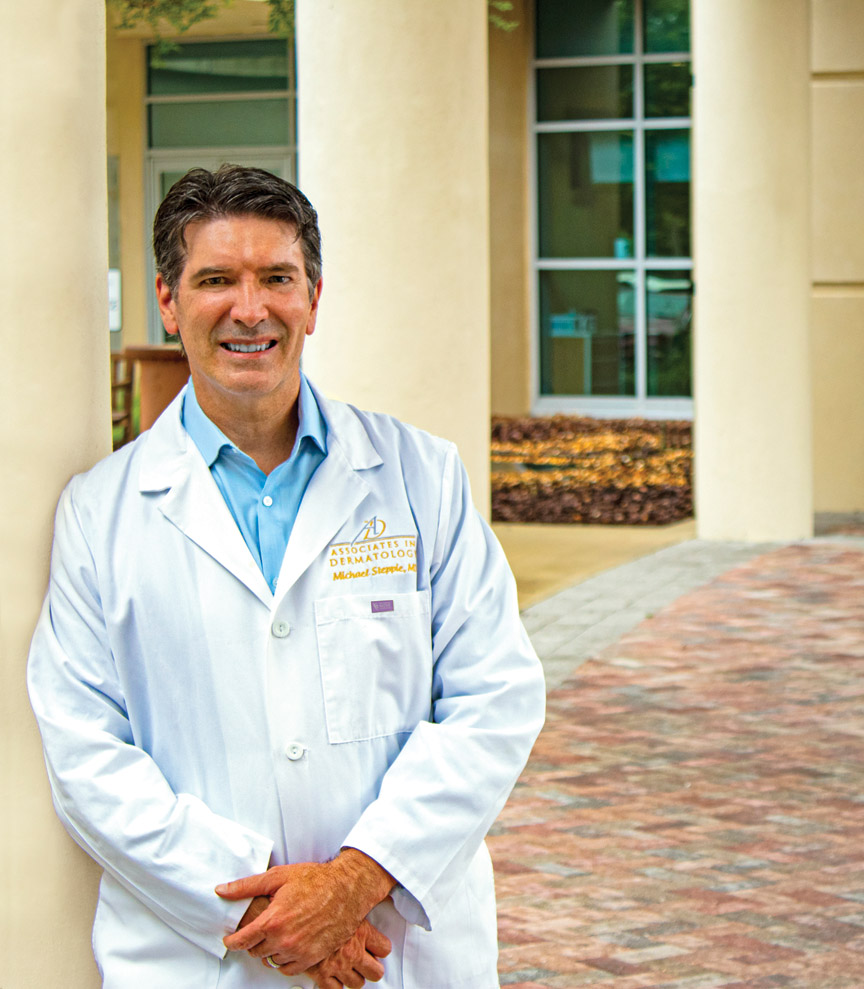
Dr. Michael Steppie and the providers at Associates in Dermatology have spent decades educating the community about establishing a proper and consistent skin care routine.
Spring’s arrival in Central Florida means a wealth of opportunities to enjoy the great outdoors, whether that’s taking in the natural beauty of the area, visiting one of the many local attractions or spending a leisurely afternoon by the pool. Of course, all that time soaking up the sunshine comes with a lot of risk, and can ultimately lead to serious skin damage and dangerous outcomes.
Skin cancer rates are steadily rising in the United States where more than 3.6 million cases are diagnosed each year, equating to more than all other cancers combined. In fact, according to the Skin Cancer Foundation, one out of every five people will develop a form of skin cancer by the age of 70. On the surface, those figures may seem daunting, but thanks to advancements in technology and treatment protocols, there’s never been more ways to combat the disease.
Here in Central Florida, expert care can be found nearby at Associates in Dermatology, founded 37 years ago and proudly continuing to deliver an unrivaled level of care to communities across the region. Its president and medical director Dr. Michael Steppie is as motivated as ever to make a difference in his patients’ lives and dispel the misinformation and myths surrounding proper skin health.
“I feel my most important goal,” he says, “is to help patients avoid the effects of overexposure to the sun, premalignant growths and skin cancer.”
And while May is Skin Cancer Awareness Month, Dr. Steppie knows full well that the battle against the disease is a prolonged fight. “Regularly practicing good skin care habits is important because Florida’s near year-round high temperatures puts us at an increased risk for cancer,” he says. “For your skin to tan, it involves using your body’s natural UV defense to produce melanin and protect your skin, but it cannot protect your skin like a sunscreen or sunblock can. A tan, for the most part, is a red flag that your skin cells have already been injured by ultraviolet light. Since UV radiation damages DNA in skin cells, it is a contributor to premature aging and raises one’s cancer risks.”
Dr. Steppie further warns that bogus claims such as “sun damage is only dangerous if you burn” is creating a false sense of security for many, especially with younger adults where melanoma incidences are on the rise.
“Unfortunately, across the Internet, algorithms of poorly regulated platforms may actually amplify sensationalism and anti-sunscreen claims, undermining scientific facts based on innumerable clinical trials,” says Dr. Steppie.
In an effort to help educate Central Florida residents about the risks of sun exposure, Associates in Dermatology has sponsored Fox 35’s UV Index feature for four consecutive years. The UV index refers to the sun’s intensity and serves as a tool to help the public gain a deeper understanding by predicting the intensity of ultraviolet radiation. Using a 1-11+ (low to extreme) scale, it provides information to determine appropriate sun protection and prevent overexposure.
That’s why it is important to keep a close eye on your skin as it not only gives you greater peace of mind, but if needed, it also helps improve your chance for successful treatment. Most importantly the daily use of sunscreen and other forms of UV protection can greatly reduce your risks of developing precancers and skin cancer.
“It may sound unbelievable at first, but the fact is that people who have more than five sunburns over the course of their lifetime double their risk to develop melanoma,” affirms Dr. Steppie.
There are three main types of skin cancer—basal cell carcinoma (the most common), squamous cell carcinoma (the second-most common) and melanoma (the most deadly). Because of the aforementioned exposure to the sun in our area, residents are particularly susceptible to the dangers of melanoma. In the past decade, melanoma rates have skyrocketed and current projections expect cases in the U.S. to reach a new high in 2026 with an estimated 112,000 cases of the invasive disease to be diagnosed. That is more than a 10% increase compared to 2025.
“Since skin cancer can affect anyone and nobody has a zero-risk factor, any strange spot on your skin or under your nails should be examined by a dermatologist,” Dr. Steppie says. “If something looks unusual to you, seek out a professional diagnosis as soon as possible because catching skin cancer at its earliest stages means treatment is much more likely to be successful.”
Many area residents entrust Dr. Steppie and Associates in Dermatology with their skin care needs, where the highly skilled team of experts is focused on proper diagnosis and treatment.
“At the end of the day, it’s important to regularly go for routine skin checks because the results can be more surprising than you might expect. Scheduling an appointment with a professional is your best chance for a proper diagnosis and individualized treatment plan. After all, that’s what we are here for: to keep your family’s skin healthy for all the seasons to come,” says Dr. Steppie.
UV Myths vs. The Truth
When it comes to proper skin care, an errant approach that promotes harmful myths can lead to increased DNA damage, premature skin aging and greater risks of developing melanoma, especially among younger adults. Here are a look at some popular misconceptions with regard to protecting your skin and the facts you really should know.
- Sunscreen causes skin cancer. There is no scientific backing that sunscreen products cause skin cancer. Clinical evidence suggests it is an essential tool in reducing the risk of developing basal cell carcinoma, squamous cell carcinoma or melanoma, which are the most common types.
- SPF 100 is significantly better than SPF 50. To say a SPF 100 sunscreen is twice as strong as a SPF 50 would be wrong, as tests show near identical protection. The truth is, that may be due to how difficult it is to be broad spectrum (protecting against UVA and UVB) while achieving a rating of SPF 100.
- Sunscreen is the only way to protect the skin. Experts recommend applying broad-spectrum SPF 30-plus daily, but along with wearing UV-protective clothing and wide-brimmed hats. In addition, the Skin Cancer Foundation says seek shade, especially between 10 a.m. and 4 p.m.
- UV rays are strongest when it’s hottest. You might have heard that you can’t get sun-damage on cloudy days, but this is another myth as UV rays easily pass through clouds. The heat of the day comes from infrared rays, as ultraviolet rays don’t generate heat until absorbed.
- Base tans protect your skin from UV exposure. This is one of the most dangerous myths, as a base tan does not protect your skin from UV radiation. The truth is, a tan is actually a positive sign of DNA damage to your skin that only offers minor sun protection of about SPF 3.
- UV damage is only dangerous if you burn. Also a dangerous myth, UV damage is harmful for everyone, regardless of skin type or whether they are subject to sunburn.
- After-care relief products repair sunburn damage. Although soothing products feel great after a day in the sun, they only fix the unpleasant side effects of a sunburn and cannot repair any of the damage that was done to the DNA inside your cells.
Associates in Dermatology
16 locations in Central Florida including:
Celebration | Clermont | Dr. Phillips | Hunter’s Creek | Ocoee
(800) 827-7546
DermOrlando.com