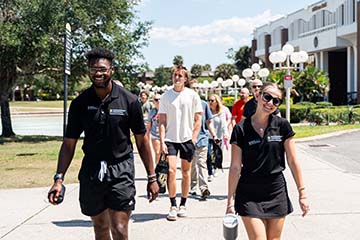
A Stroll Around Campus
College visits and tours provide valuable insight and the chance to experience a school’s culture.
Choosing a college is one of the most impactful decisions a person can make, not only affecting the two to four years in which they attend the school, but the rest of their lives. This can make the process a stress-inducing experience, especially when navigating the daunting task of touring and visiting the institutions in person.
In order to relieve some of that anxiety and help soon-to-be college students, representatives from a number of campuses throughout Central Florida offered their advice on how to best approach these visits in order to make an informed decision for their future.
Each school official emphasized the importance of asking questions about campus culture, the types of facilities that are available for students, the sports, extracurricular and recreational programs available, and what majors, minors and certificate programs a particular school offers.
Ringling College of Art and Design’s Dr. John Chopka, vice president of enrollment management and marketing, specifically advises prospective students taking a campus tour to ask the student tour guides not only what they like about the college, but also what they think needs improvement.
“It’s OK to ask a student tricky questions, like, ‘What’s one thing you would improve about your experience at this university?’ Even though students are trained to give good tours, they’ll be transparent. They’ll let you know, ‘Well, I wish this was stronger,’ or ‘I wish this was open later,’ and they’ll give you some good ideas,” says Chopka.
Christopher Dahlstrand, director of admissions, communication, marketing and visitor experience at the University of Central Florida (UCF) also highlights the importance of doing research on the school beforehand. As one of the largest universities in the nation, there’s a lot of ground to cover and the sheer size of the campus can be overwhelming for visitors.
“Sometimes when they get here, they sort of freeze and forget what they wanted to know and realize on the drive home, ‘I wish I had asked this.’ So have those questions written down in a little notepad or on your phone and then seek out those opportunities to get them answered. Meet the students, ask the staff, encounter and engage with our faculty, and I think that then they’ll find that this visit was worth their while,” says Dahlstrand.
Florida Institute of Technology’s executive director of admission Michael Perry also emphasizes that any prospective student should evaluate what the purpose of their campus visit is.
“They need to decide what their goals are for the visit before they schedule it. … People determine culture, and feel and fit differently. It’s not the same for everybody. So they have to answer their own question on that first, then schedule a visit and try to get those questions answered,” says Perry.
Meeting with staff, faculty, students, advisors and the financial aid office professionals is also recommended at Rollins College, with the school also offering ways for students to center their visits around meeting with financial aid professionals if they choose to do so.
“We allow students to kind of choose from a menu of options, like sitting in on a class or a subject area that’s interesting to them, meeting with a professor, having coffee with a student or having an in-depth conversation with financial aid. So those are all of the things we allow students to do that gets a little bit deeper into the campus, as opposed to just taking the tour,” says Faye Tydlaska, vice president of enrollment and marketing.
Valencia College, a community college partnered with UCF, has specific First Stop offices set up for those looking to learn more about various elements of the college experience on their tours.
“During campus tours, our Outreach and Recruitment staff recommend that visitors go to our First Stop offices to ask additional questions and receive hands-on assistance related to admissions, financial aid and enrollment,” says Keisha Jordan, assistant director of the college’s outreach and recruitment team.
Of course, one of the main purposes of touring a campus is to see the facilities and experience the environment first hand, which can help provide an overall feel for the school.
While all schools have classrooms, some have unique spaces for visitors to explore. Some of these areas include labs, or in the case of art schools like Ringling, art studios and galleries.
Full Sail University, renowned for its programs in media and entertainment, also offers labs and studios, as well as production facilities.
“Prospective students can explore the spaces, places and environments across our 210-plus acre campus that they would be experiencing along their student journey—from 110-plus studios and labs, to production environments and collaborative areas. We provide in-person daily tours and our monthly behind-the-scenes tours to allow folks to experience our campus first-hand. Seeing students actively creating in our campus spaces brings the experience to life,” says Andrew Mund, director of touring and support.
At Florida College, a religious institution aimed at Christian college students, those taking tours of the campus are encouraged to visit the chapel, as it is an important part of daily life on campus.
“At the core of who we are is a Christ-centered learning environment. And chapel happens every day at 10:15. So when a student comes to our campus, we say, ‘Hey, you got to come at 10:15 because you have to see the chapel.’ They get to see the core of who we are. And that’s just unique to who we are at Florida College,” says Josh Jones, director of admissions.
Living spaces can also be unique at some schools, with Stetson University offering pet-friendly housing, allowing students to live with their dogs, cats, fish or other small, domestic animals.
“You can’t bring your pet horse or your pet goat, but you can bring your dog or your cat, your fish or whatever. … You’ll see lots of dogs walking around campus here,” says Jeffrey Gates, Ph.D., senior vice president for Stetson.
Besides a standard tour of the campus, another way to get a feel for a particular college is to shadow a student for a day, or sit in on a class, though not all schools offer this option.
UCF will allow shadow visits or class sit-ins when safe, secure and physically practical, though in some lab environments it’s not an option, leading them to make other arrangements for prospective students to get a feel for these spaces. Valencia College, also does not offer shadow visits in the traditional way.
“We do not currently offer formal shadow visits. However, when requested, we may coordinate opportunities for prospective students to engage with our campus outreach assistants, who are current work-study students and can share firsthand experiences about life at Valencia College,” says Jordan.
Florida Institute of Technology offers some class sit ins if feasible, though Perry suggests that students meet with department chairs and visit during weekdays during the fall or spring semesters when the campus is full, to better get a feel for the school.
“For us, it’s better for the students to talk with the professors about a specific major and what they’ll be doing. And they’ll be able to talk about all the different types of classes and things that they’re going to do, not just one,” says Perry.
Full Sail University, Florida College, Ringling College, Rollins College, and Stetson University all offer chances for visitors to sit in on classes as long as they are in session during their tours or visits, though some do require prior notice or registration.
Each college also offers their own unique ways to get prospective students acquainted with the campus and its surroundings. Stetson University offers its Hatter for a Day visits, where visitors attend real classes, eat the dining hall’s food, interact with students already in attendance and meet the professors in their area of interest.
For Rollins, Tydlaska encourages those on tours to walk down the nearby Park Avenue, which she says operates as almost an extension of the campus to get an idea of what the surrounding community is like.
UCF and Ringling both offer daily visits Monday through Friday, as well as some weekend events so that the visit can be scheduled conveniently for almost anyone’s schedule.
Florida College offers private tours for both families and individuals that cater to the visitor’s interests as well as their Experience FC days,, which are held four times a year and offer the opportunity to meet professors and get a feel for the campus culture.
While it is advised that those looking to attend college begin researching schools and scheduling campus tours, the most important thing on a college visit is for the prospective student to get a better sense of what direction they want to move in to build the future they want for themselves.
“It’s about fit. Does the college make a student feel comfortable and at home? Because if you visit a place and they have all the modern technology, and they’ve got incredible facilities, but you don’t feel at home, you don’t feel at peace, then you need to dig deeper to see what is it that’s keeping you from having what I call your ‘aha moment,’ when a student visits campus, and it just feels right,” says Chopka.