What’s Good For Business
The business minds behind Shark Tank share their keys to success, motivating others and more.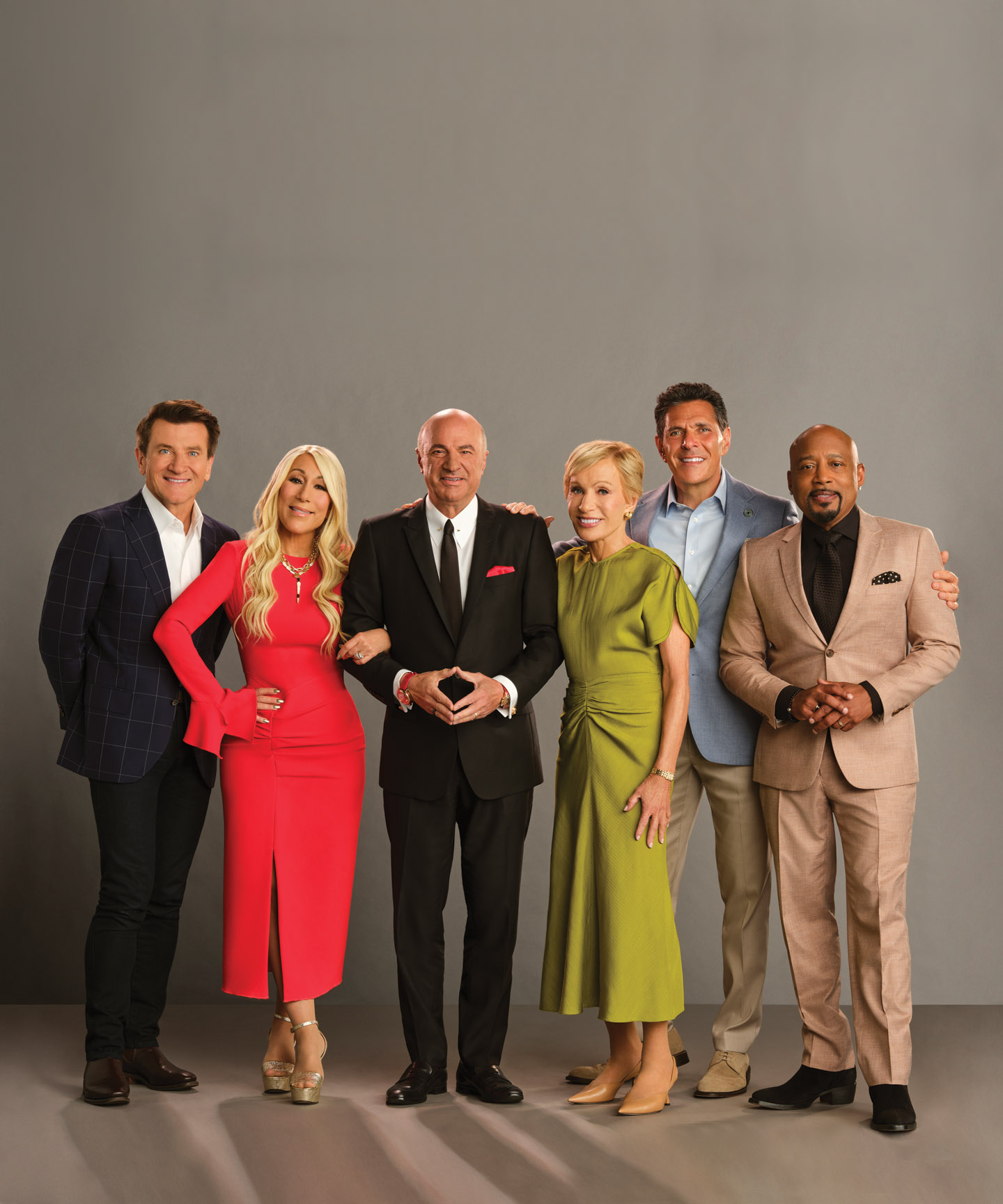
For 17 seasons, a group of self-made entrepreneurs has been holding court on an extremely popular reality TV show that has changed the business landscape.
With millions of viewers watching, Shark Tank quickly became a TV hit, inspiring countless inventors, entrepreneurs and dreamers who have auditioned to pitch their ideas, products and brands in front of the business experts. The goal is to go home with not only an investment of money from the Sharks, but to gain a seasoned mentor and advisor to help them scale their business.
Four of the TV Sharks—Robert Herjavec, Barbara Corcoran, Daymond John and Kevin O’Leary—are all self-made millionaires who are eager to share both their professional and life advice in hopes of mentoring the next great business minds.
Over the course of its 16-season run, the core four, along with many other guest Sharks throughout the years, has made dreams come true for countless folks looking for their big break. Those life-changing experiences have continued during its latest season, which currently airs on ABC on Wednesdays at 10 p.m.
“I think the biggest impact from Shark Tank is the ability to hear from people who have actually built businesses, and to learn how to talk business,” explains Herjavec, a Canadian tech mogul and venture capitalist who founded his first business in his late 20s. “How many people ever get a chance to meet somebody who started a business?”
‘You Have to Find Your Why’
Herjavec says that one key to success in building a great business, or any other endeavor, is having the ability to believe in yourself and to understand your motivation, or the why, for all of the hard work. “I was very fortunate to figure out ‘my why’ really early in my life. I think a lot of people drift along, and [feel] fear that can be all-consuming.”
Herjavec credits his parents for instilling a strong work ethic and deeply-rooted resilience by giving up everything in their native Yugoslavia and fleeing to Canada, where they did not speak the language, lived in someone’s basement and worked tirelessly to allow their son to pursue his dreams.
He vividly recalls a night when his father, Vladimir, came home from working at the factory to take a shower and eat dinner before working a second shift.
“I looked at him, and I said to myself, ‘I will never in my lifetime work as hard as that man is working right now,’” Herjavec recalls. “And that was it. So, how do I then not acknowledge and justify that sacrifice? And that was my why.”
‘Find the Gifts in Each of Your People’
Corcoran recalls the day she started her real estate firm, The Corcoran Group (which she sold for $66 million in 2001), which she modeled after her nurturing family life. She says that it was all about finding passionate people, building loyal teams and creating a positive culture that attracts high-performing people that fuels authentic, lasting growth.
“I had a wonderful role model at home. This started with my mother, Florence, who raised 10 children in a two-bedroom flat. She identified the gift in each of her children,” Corcoran shares. “My first ingredient was taking on the attitude that my mother had; I was going to work for my people, they were never going to work for me.”
The self-proclaimed “fun master” added that another business staple for all of her companies has been to “always hire happy people.”
“Why would you waste your time with unhappy people? If you get a complainer in your group, one spoiled apple ruins the bunch. You have to protect [your employees], that was my job as a boss,” she says.
Corcoran strongly believes that a successful business is based on several factors. “Recognition motivates people as much as money does,” she offers. “Know who you are hiring and what their natural gift is. Always hire happy people and [know that] fun is good for business.”
A strong proponent of bouncing back and finding resilience, Corcoran explains that “there are a million reasons to give up a journey, because it’s not easy. There are a million reasons not to recover from rejection because it doesn’t feel good. You are going to have to jump over 10 obstacles to reach one, and you are going to have to bounce back from the others.”
From Rags to Riches
John is best known for his company, FUBU, which he founded in his mother Margot’s apartment in 1992. He credits her strong support for his early path to success.
“This meant everything in the world to me,” he says. “Every single person, whether you start off with your mom, or the teacher who believed in a little dyslexic brown boy and told him, ‘We will figure this out.’ To say to any of those people, ‘You bet on the right horse, thank you for doing this,’ is always gratifying.”
John hopes his success story and journey to the top can serve as an inspiration to others. “I don’t sugarcoat it; it’s not going to be easy. But if you look at me: I didn’t come from any money, I have no famous last name, I got left back in school, I am dyslexic, I was raised by a single mother, had no formal education besides maybe high school … if I can do it, then you can do it, too, ” he says. “Sixty-five percent of Forbes’ top wealthiest 1,000 people are all self-made men and women, so why can’t you do it?”
John is filled with pride that he invested in the sock company, Bombas, the No. 1 product in the history of Shark Tank. The social component of the business run by founders Randy Goldberg and David Heath was key—for every pair of socks sold, one is given to the homeless.
“Bombas taught me what it means beyond being a successful business, because we are in the communities,” John says. “It shows me that you need to double down on why people buy a product, and that’s exactly what’s important about them.”
Investor and ‘Mr. Wonderful’
O’Leary, the self-proclaimed “Mr. Wonderful,” often comes across on Shark Tank as abrasive, so it is interesting to note that when asked if he views himself as more tough than tender, he replies, “I just prefer to tell the truth. It’s so much easier that way. My mother told me once, ‘If you always tell the truth, you will never have to remember what you previously said.’ And I just carried that forward.”
He knows that not everyone appreciates his blunt style, “but I don’t care. It’s important in business to explain that it’s just my opinion, but if I think [a deal] is a loser, I am going to tell you why.”
“When I see entrepreneurs three years into a deal and it’s not working, I tell them, ‘Not only are you wasting your valuable resources of money, but you’re wasting your time. It’s begging to be taken behind the barn and shot. [The universe] is sending you messages, and you’re not listening,’” O’Leary adds.
After 17 years of the Shark Tank journey, O’Leary is extremely proud of what the series has built. “We have an iconic global platform. The show is on in more than 50 countries, and wherever I travel in the world today, I feel like an ambassador for the American dream. I’m also proud of [the show] because [these businesses] create jobs.”
For O’Leary, “Shark Tank has given me an appreciation for the journey of entrepreneurship. It’s a journey and not a destination, and very often it ends in heartbreak. It’s hard. And not all of our deals work; that’s just the nature of venture capital. It’s hard to tell someone that their deal is going to die; but it does happen.
“But every once in a while, and in the case of Shark Tank, quite often, we create huge businesses and thousands of jobs and hundreds of millions in sales. And it just happens. It has been a wonderful experience to be part of something that shows that one good idea can change your life forever.”