


 28 / 40

Making
ADIFFERENCE
Gift of Life
The Lifesaving Impact of Blood Donation
J
anuary is
National Blood Donation Month
and the need for
donors cannot be overstated. According to the American Red
Cross, a person in the United States needs a blood transfusion
every two seconds. It is reported that 1-in-3 people will need
a blood transfusion at some point in their lives. Quite simply:
Donation is essential to saving lives!
Although all blood is made of the same basic elements, the
Red Cross explains that not all blood is alike. There are eight
different types, which are determined by the presence or absence
of certain antigens. Since some antigens can trigger a patient’s
immune system to attack transfused blood, safe transfusions
depend on careful blood typing and cross-matching. The blood
type that is most in demand is O negative, the universal blood
type. For example, it plays a critical role in trauma situations when
a patient’s blood type is unknown because it can be immediately
transfused as a short term solution. Blood isn’t just necessary
for those suffering trauma. Patients who receive chemotherapy
treatment, have sickle cell anemia, or received an organ transplant
also rely on blood transfusions.
A constant supply of blood is crucial, especially since there
isn’t a substitute for it. The only source of this precious, life-
giving elixir is the generous donors. “Donating blood is one of
the most powerful actions any human can take. Your donation
will literally save someone’s life. It is that profound,” says Pat
Michaels, manager of media and public relations for OneBlood,
a not-for-profit, community-focused organization that works
to provide safe, available, and affordable blood to hospitals and
their patients. OneBlood serves more than 200 hospitals and
health care facilities in Florida and parts of southern Georgia and
Alabama. Strategically located laboratories and distribution centers
throughout this region allow the organization to respond quickly
to ever-changing needs.
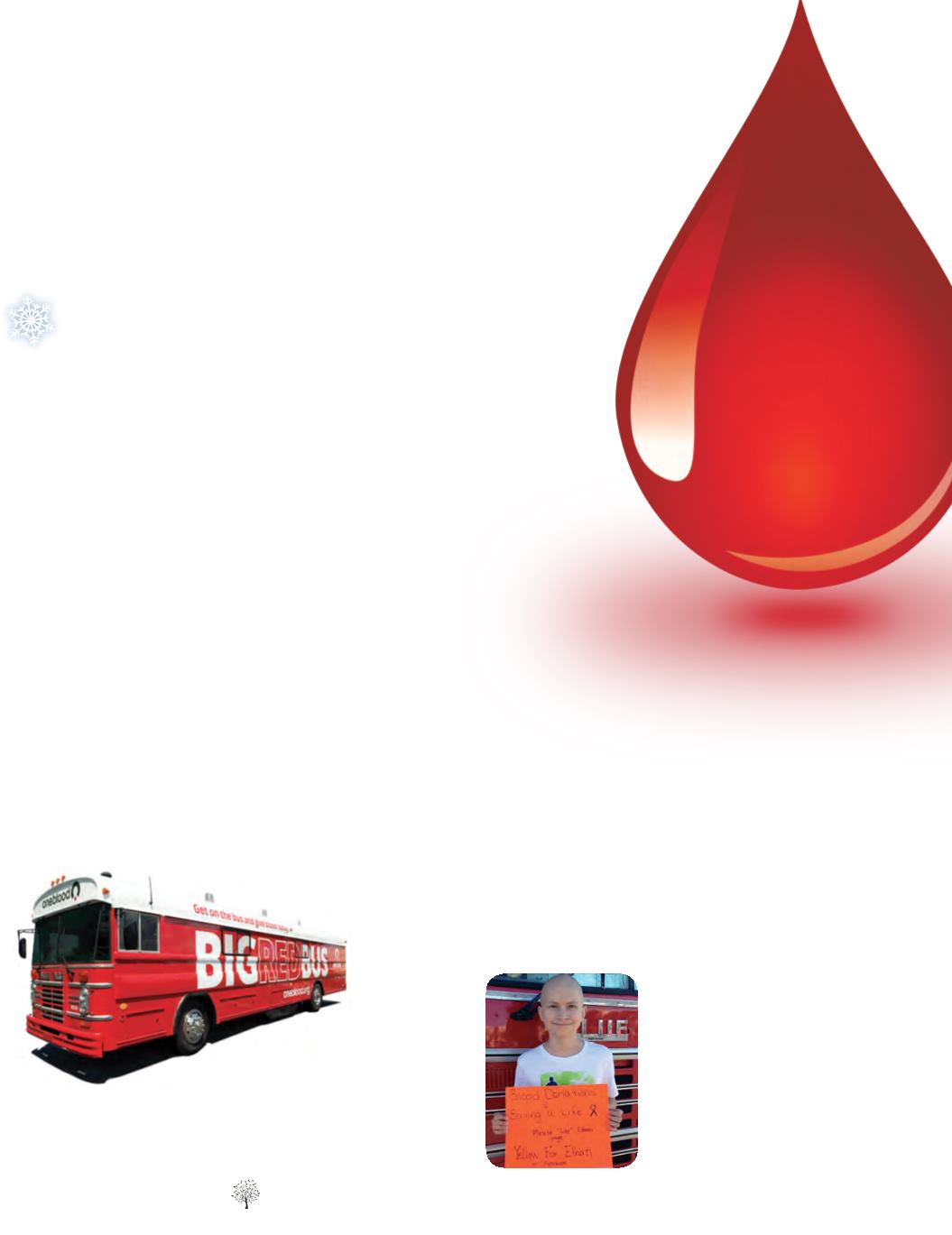
OneBlood’s iconic Big Red Bus is one of few mobile donation
centers in Florida that park in convenient locations to capture the
maximum amount of donations. But the organization
strives to make donation easier for both
regular and first-time givers in
other ways too. “We
have a program
called
Target
Your Type
that
empowers
donors to learn
about their
blood type and give
it a certain way,” Michaels
shared. “Many of our career blood
donors give platelets that directly impact
cancer patients. These donors can give several times a
month and understand the power they hold.”
OneBlood reports that out of the 39% of the population that
is eligible to donate blood, only 5% do. Among other efforts,
the organization works to
increase this percentage
by telling the stories
of both donors and
recipients.
Tom and
Cyd Frank of
Longwood can
be considered
super donors.
Together, they’ve
given more than
13 gallons of
blood, instilled
a passion for
donation in their
children, and
celebrated their 30
th
wedding anniversary
by donating together,
hand-in-hand. “I used to
bring my youngest (child) in a
stroller every time I gave. She just reached
the eligible age but hasn’t given yet because her heart rate was too
high,” Cyd explains. “I guess she was too nervous but she won’t
give up because she, like us, understands how important her
donation is for others.” Cyd says her family gives because they are
blessed to be able to do so. “There are families whose loved ones are
struggling to stay alive and my generosity just might save them. It
is a priceless donation that I don’t have to write a check for.” The
need has, in fact, hit close to home as the Franks say both a friend
and relative have benefited from blood transfusions.
Survivor Ethan Wright knows the value of that donation all
too well. The Lake Minneola High School student was diagnosed
with a rare bone cancer, Ewing Sarcoma, in 2013. That summer
he began his treatment, regularly receiving blood transfusions and
platelets as each round of chemotherapy could not begin until
Ethan met certain blood levels.
“We learned first-hand the importance of blood donations at
this critical stage,” proclaimed Colleen Wright, Ethan’s mom. “We
held a blood drive and encouraged
others in the area to do the same
through Ethan’s Facebook page,
Yellow
For Ethan
.” Ethan underwent surgery
and finished treatment in February
2014. “Little did we know that Ethan’s
journey was not done,” Colleen says.
In July 2014, Ethan discovered he had
developed myelodysplastic syndrome,
a blood disorder that, if left untreated,
would lead to leukemia. The only cure
was a bone marrow transplant.
By Justin Braun
ORLANDO FAMILY MAGAZINE
JANUARY 2016
28