


 29 / 40

“We met with a team of doctors and
BeTheMatch.orgto find a bone marrow
donor for Ethan and he had his bone
marrow transplant on November 14, 2014.”
Throughout the transplant process, Ethan
received hundreds of units of platelets and
red blood cells transfusions until his body
was able to produce enough on its own. “We
just celebrated his one year re-birthday and
urge everyone to give blood and thank all
those who do. You saved our son’s life!”
Donors may not realize that they also
impact their own health. According to
studies published in the
American Journal
of Epidemiology
, blood donors are 88% less
likely to suffer a heart attack and 33% less
likely to suffer any type of cardiovascular
event. Why? One theory is that iron has
a significant impact on atherosclerosis
(hardening of the arteries) and you can
remove 225 – 250 milligrams of iron from
your system through blood donation which
decreases cardiovascular risk. Plus, centers
provide a free mini-physical and monitor
blood pressure and cholesterol. Learn more
at
OneBlood.org.
Blood Donation Basics
To donate blood, you must be in good
health, at least 16 years of age (minors need
a completed and signed Parental Consent
Form), and weigh a minimum of 110 pounds.
You may feel a slight sting as your donation
begins (lasting only seconds), but there should
be no discomfort.
The body contains 10-12 pints of blood.
A typical blood donation equates to
approximately one pint.
A donation takes about 5-10 minutes. The
entire process, from registration to post-
donation refreshments, is about one hour.
Be sure to eat well at your regular mealtimes
and drink plenty of fluids prior to donation.
You may donate blood once every 56 days,
which allows plenty of time for red cells to
replenish.
To locate a donation center or Big Red Bus,
visit
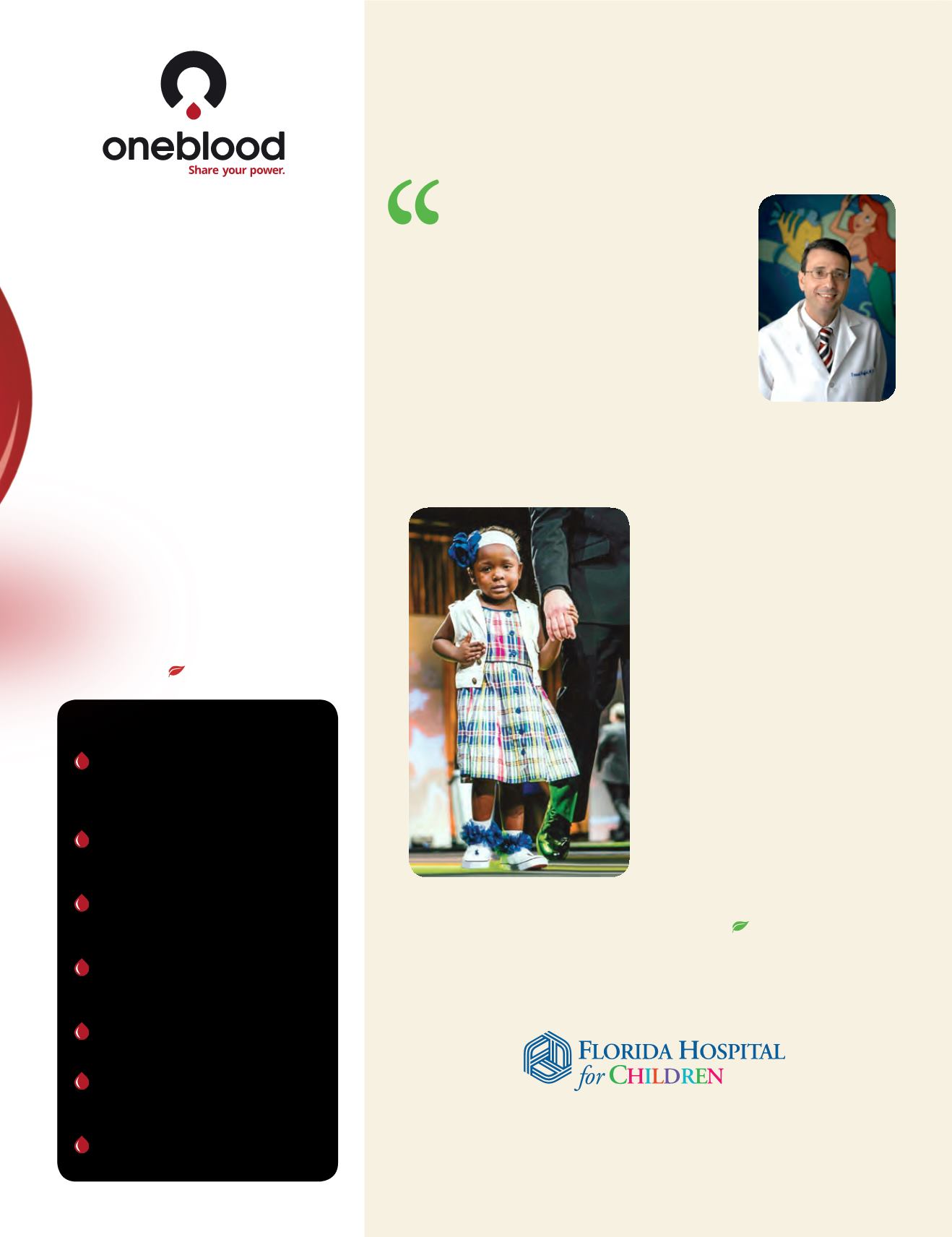
OneBlood.org/Locations. A D V E R T O R I A L Kicking Cancer: Eden’s Story She had already been very ill as a baby, so to go through this again was unbelievable,” Tashas Wilson says about her two-year-old daughter’s diagnosis of stage four neuroblastoma, a type of cancer that starts in early forms of nerve cells. Little Eden Daniels already had spent her first Christmas in the hospital battling pneumonia. Now, as a toddler, she would have to fight again. In May 2014, Eden started running fevers with no known cause. Doctors were stumped. The following month, Tashas brought Eden to the Emergency Department at Florida Hospital East Orlando after Eden complained of severe stomach pain. An ultrasound detected a tumor located on her kidney, and she was immediately transported to Florida Hospital for Children, where Fouad Hajjar, MD, diagnosed her with stage four neuroblastoma. “It’s not what you want to hear,” Tashas admits, “but support from the hospital staff was great. The worst part was the diagnosis. They made everything after that easy.” Eden started treatment right away, with five rounds of chemotherapy to shrink the tumor, and then 12 hours of surgery, led by Chris Anderson, MD, to remove it. “You have a fighter,” the doctor told Tashas after the surgery. By January 2015, Eden’s scans revealed no active disease, and she was declared cancer-free. “God can do what seems impossible, and that’s what keeps me smiling,” Tashas says. The Children’s Center for Cancer and Blood Disorders at Florida Hospital for Children is a full service hematology and oncology program, featuring Central Florida’s first and only Pediatric Bone Marrow Transplant program. Learn more about its physicians, facilities, and treatments FloridaHospitalForChildren.com/Cancer. www.FloridaHospitalforChildren.com29