Her Boldest Chapter Yet
Anne Hathaway continues to reinvent herself during a busy year that includes three major movie roles while expecting her third child.
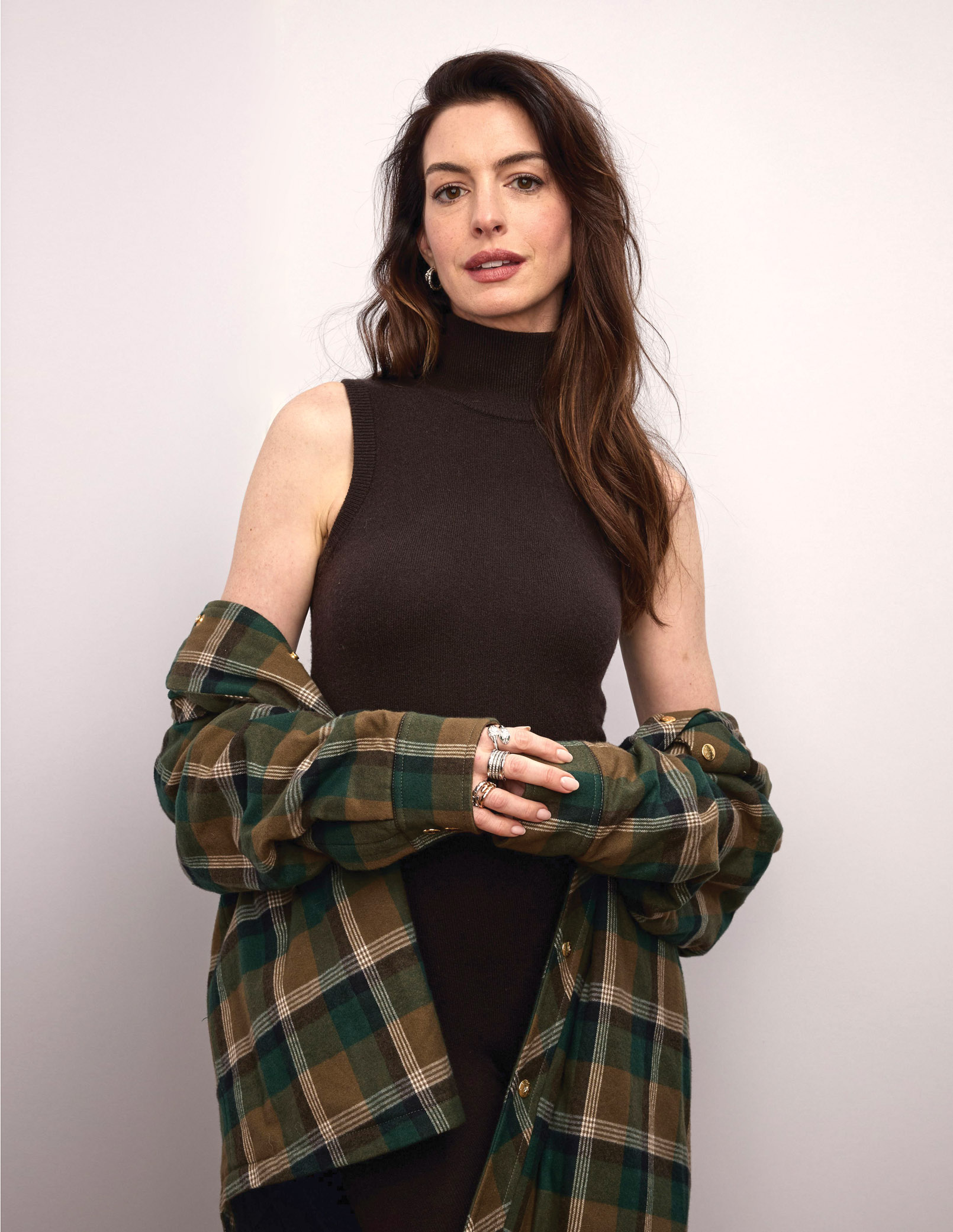
Anne Hathaway has always been something of a paradox. For an actress whose career spans fairy-tale beginnings, Oscar-winning gravitas and blockbuster spectacle, there remains something distinctly un-Hollywood about her—an openness, a self-awareness and a willingness to interrogate both her craft and herself.
Now in her early 40s, the Oscar winner enters a new phase of her career with the kind of confidence that can only be earned. The industry that once tried to define her has, in many ways, been outpaced by her own evolution. She has switched between genres and expectations, balancing prestige drama with mainstream appeal, while increasingly stepping into projects that reflect not just ambition, but authorship.
That journey came full circle this year with The Devil Wears Prada 2, a return to one of her most iconic roles, Andy Sachs, all of two decades on. Alongside it came a slate that underlined her range: the epic sweep of The Odyssey, and the unsettling suburban mystery of The End of Oak Street, both reinforcing an instinct for contrast and reinvention.
Away from the screen, Hathaway’s life has shifted in equal measure. Motherhood, perspective and a quieter relationship with fame have all played their part in shaping an actress who feels both more grounded and more creatively liberated than ever.
Hathaway took a break from her extremely busy year—she is also expecting her third child with husband Adam Shulman—to discuss her latest projects and how she deals with life in the limelight.
Your role in The End of Oak Street feels like one of your most unusual projects in years. What drew you to it?
It’s one of those scripts where you read it and you can’t quite categorize it, which is usually a very good sign.
On the surface, it has these big, almost fantastical elements—a neighborhood that no longer behaves like reality, and a sense that something ancient and unpredictable is encroaching—but underneath it, it’s really about a family trying to hold itself together.
That contrast really spoke to me.
You play Denise, the matriarch at the center of the story. How would you describe her?
Denise is someone who believes she understands the rules of her world, and then suddenly those rules disappear.
What I found interesting is that she doesn’t respond with panic in the way you might expect. She becomes very focused, very practical. She’s holding her family together in a situation where there are no clear answers.
There’s a quiet strength to her, but also a constant recalibration: She’s adapting in real time to something that doesn’t make sense.
The premise is extraordinary. How did that translate on set?
You’re acting against something that isn’t always there yet, which requires a lot of trust. Of course when you make any movie with Ewan McGregor you know you’re in for a fantastic time, and it really was one of those that we didn’t want to end.
There’s a real ease to working with him, which is essential when you’re playing a couple under pressure.
We spent a lot of time talking about the family before we started—how they function, what their history is—so when everything starts to fall apart, it feels grounded in something real.
It’s actually been in the can for quite a while now, so is one of those moments where you’re having to reunite yourself with a story that is long since in the past.
The film blends family drama with science fiction and tension. Did that tonal mix appeal to you?
Very much. I love when genres overlap, because that’s closer to how life actually feels.
There are moments that are genuinely tense, but they’re always rooted in something human—fear for your children, uncertainty, the instinct to protect what you love.
That’s what makes it work. If it were just about spectacle, it wouldn’t be nearly as interesting.
The film was shot in London. How did you find working there again?
I love London. I always have. There’s something about the city that feels both incredibly historic and completely alive at the same time. Probably more than any other city in the world, there is so much there that’s new, yet so much that’s old and based in real history.
Even just walking to set in the morning, there’s a feeling of a city just bursting with people, yet backed by the memories and ghosts of the millions who have lived there before. It’s a place that really gets you in the moment.
Earlier this year you revisited Andy Sachs in The Devil Wears Prada 2. What was your first reaction when the idea was put to you?
It was complicated, honestly. My instinct is always to protect something that people have a real connection to. That film means a lot to people, and I didn’t want to revisit it unless there was a genuine reason.
But when I read the script, I realized this wasn’t about recreating something; it was about continuing it. Andy isn’t the same person anymore, and neither am I. That distance is what made it feel worthwhile.
I like the idea that we all change with time, and it’s OK to show that.
How did your understanding of Andy change with time?
I have a lot more compassion for her now. When I first played her, I think I was quite focused on her ambition, her drive, her sense of being overwhelmed.
In the time that passes, your view of everything in life changes significantly. Certainly, you learn to view things in the moment, and I could see how young she was, and how much she was still figuring out—again, much like myself!
There’s something very human in that—wanting to succeed, but not quite knowing what success looks like yet.
Coming back to her felt less about proving something and more about understanding what she’s learned.
You’ve also got The Odyssey, which is obviously a very different scale and tone. What drew you to that project?
I loved the idea of stepping into something that feels almost mythological in its weight. It’s a very Christopher Nolan movie: It’s big, it’s about journeys and wars and, of course, the famous Homer’s Odyssey. I remember studying the text when I was in school, and never in my wildest dreams did I imagine I’d be representing it again in this way.
I think when you’re working on something that has existed in human storytelling for so long, there’s a responsibility to honor that, but also to make it feel immediate.
Does working on something so epic change your approach as a performer?
It requires a different kind of focus. With something like that, everything is heightened—the scale, the emotion, the physicality.
But at the same time, you have to find the intimacy within it. If you lose that, it just becomes spectacle.
There was a period where you were very publicly scrutinized. How did that shape you?
It was difficult, but also incredibly instructive. It forced me to understand what I could control and what I couldn’t. And ultimately, you can’t control perception—you can only control how you show up. That was a very important lesson.
Do you feel more comfortable in your own skin now?
Definitely. I think that comes with time. You realize you don’t have to perform in your own life. You can just be who you are, and that’s enough.
You’ve taken on more producing responsibilities. How has that shifted your perspective?
It’s made me feel much more connected to the work as a whole. You’re not just thinking about your role—you’re thinking about the entire story, how it’s told, how it’s experienced. That’s very fulfilling.
Has motherhood continued to influence your choices?
Completely. It changes your relationship with time, with energy, with what feels important. I’m much more intentional now about what I say yes to.
Looking ahead, what kind of projects excite you most now?
The ones that surprise me. The ones that feel slightly out of reach. If I feel completely comfortable, it probably means I’m not pushing myself enough.
Finally, what grounds you now?
My family, always. And curiosity.
Also staying open, staying interested—that’s what keeps everything moving forward for me.