Road Rules
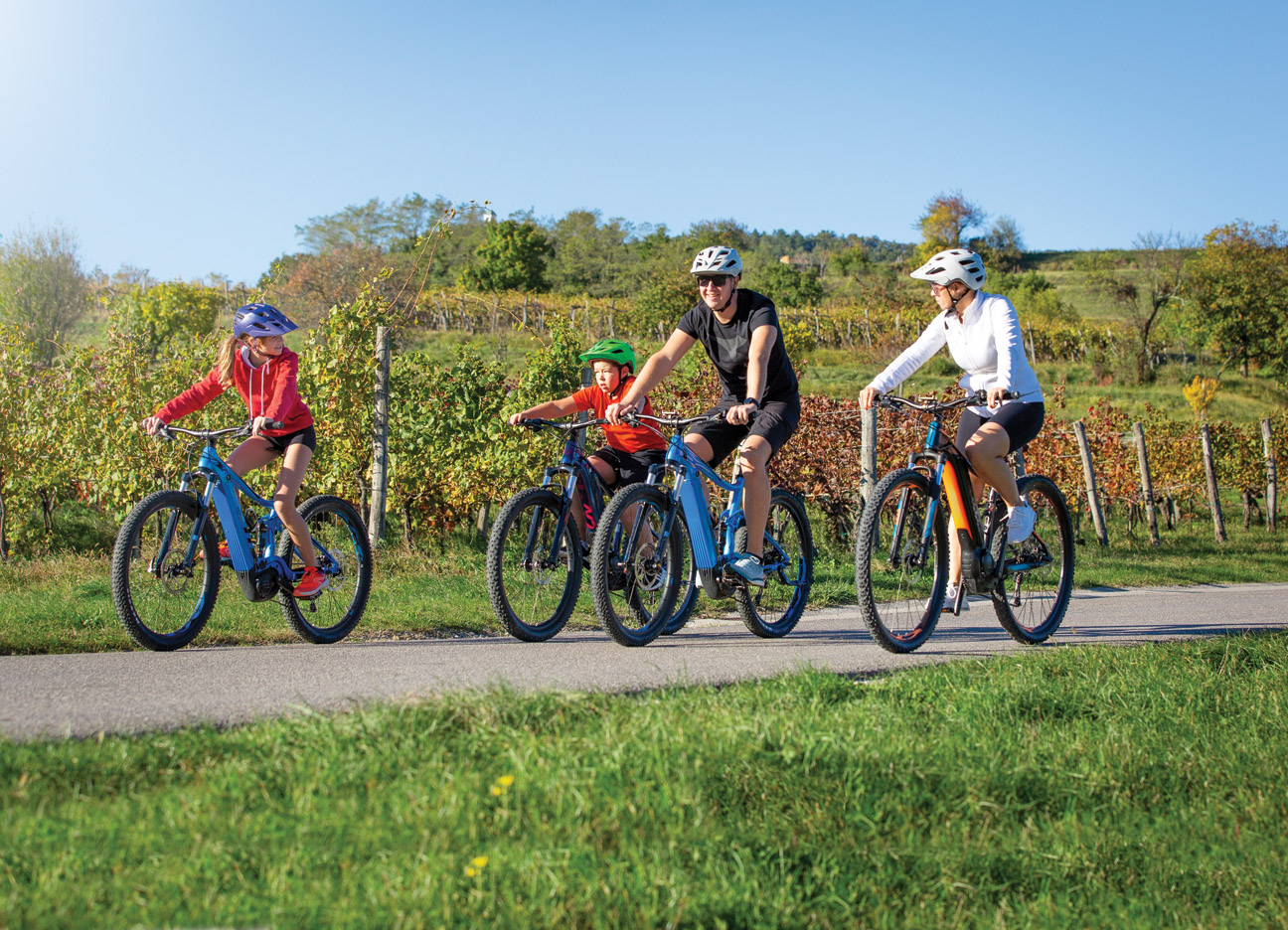
As e-bikes become more and more popular, especially with kids, parents are encouraged to learn more about the devices and how to keep their children safe.
Alan Duke admits that he has a love-hate relationship with e-bikes.
A board member for a local cycling club known as the Florida Freewheelers, Duke has been an avid traditional cyclist for about 15 years and rides at least once a week. His club welcomes e-bikes as long as they have pedals, and he believes they have many benefits, including helping those with mobility issues get around easier. He doesn’t own an e-bike, but he has been on one and recognizes the appeal.
Like so many around the state and the country, however, Duke has become worried about the rising number of serious accidents, including fatal crashes involving children.
“The safety aspect of it concerns me,” he says. “I think they’re really cool—that’s the flip side—but I’ve seen a lot of people riding them inappropriately. I’ve seen people go opposite the flow of traffic, and I’ve seen teenagers doing long wheelies for half a mile. On the one hand I’m impressed, because I can’t do a wheelie like that, but I also think it’s hugely irresponsible to be passing cars and going 30 or 40 miles an hour while popping a wheelie.
“I’ve got opinions on both sides of it, but they’re here to stay—these e-bikes aren’t going anywhere, so I think we have to learn to ride effectively alongside them, advocate for safety and accept the fact that they’re here.”
E-bikes—a general term that has been used to describe everything from pedal-assist electric bicycles to e-motos that resemble mopeds or motorcycles and are much more powerful and faster—have become increasingly popular in recent years for people of all ages, but concerns about their safety, especially for children, continue to be raised.
Dr. Corinne Bria, a pediatric emergency medicine physician from Nemours Children’s Hospital, has noticed an increase in serious injuries from e-bikes over the past two to three years. She believes the three main factors are the high speeds at which they’re capable of going, the heavier weight of the devices compared to regular bikes, and the difficulty for children in the 10-to-16-year range to react to the stimuli around them while they are riding.
“One of the things I think is really important to talk about is that when we have children who come in with falls from a [traditional] pedal bike or scooter where they use their foot, they have bruises, they have brush burns, and they might even have lacerations or cuts that require stitches,” she says. “But what we’re seeing with the e-bike and e-scooter injuries is more serious. We’re seeing broken bones, and not only broken bones but broken bones that require surgery to make sure the bone is healing properly. The gravity is much greater.”
Rachael Maney is the law firm director of Wilborn Law in Winter Garden and the national director of Bike Law, a network of bike crash lawyers across the country. Bike Law was founded by Peter Wilborn, who lost his brother to a fatal bike accident in 1998. Maney, a former elite triathlete who represented Team USA, was forced to retire from competition when she was seriously injured on her bike after being struck by a car.
Clearly, the issue of bike safety hits home for both of them, and Maney agrees that the accidents frequently occurring are alarming. But she makes an important distinction between e-bikes and e-motos, the latter of which she believes are involved in most crashes.
“It’s an incredibly important topic but it’s actually a lot simpler, I think, than everyone is making it,” she says. “To begin, all electric bicycles as defined by Florida law are bicycles. They cannot have a power or wattage that is greater than 750, they must have pedals and they’re capped at going 28 miles an hour. Not all e-devices are e-bikes, however, and I think a big part of the problem is that there has been a lack of differentiation and clarification about the actual devices that are involved in this astronomical surge of horrific, catastrophic and fatal crashes, most of which are involving children.
“If it doesn’t have pedals, it’s not an e-bike, by law and by definition. It is an e-moto, and those are already not allowed on shared-use paths and sidewalks, and should require licensing registration, insurance and a driver’s license to operate.”
Florida recognizes three classes of e-bikes. Class 1 does not exceed 20 miles per hour, only works when riders are pedaling and has no throttle. Class 2 also does not exceed 20 miles per hour, but has a throttle to work without pedaling. Class 3 can reach a speed of 28 miles per hour and is a pedal-assist bike with no throttle.
None of them require a driver’s license, registration or insurance, as states like New Jersey and California have implemented for certain types of e-bikes. Helmets are only required for those under 16, and the only age requirement is for Class 3, which riders must be at least 16 to operate.
“We are huge proponents of e-bikes, of all classes,” Maney says. “They provide autonomy to individuals who otherwise would not have it by making efficient and affordable transportation accessible. We have a significant elderly population in Florida that relies on e-bikes for transportation, and kids being outside instead of on devices inside is always a good thing. The problem is when you’ve got a sixth, seventh or eighth grader say, ‘I want an e-bike for Christmas,’ and the parents go to Amazon and see these things that look kind of like e-bikes, but they’re not understanding … that something that is 3300 watts or 2500 watts that goes 50 miles an hour is not appropriate for a 12-year-old to be on, darting off of a sidewalk.”
Some municipalities in Florida extend the state regulations with stricter laws, such as helmet requirements, age restrictions and banned use on certain trails. Orange County Public Schools adopted a new policy for this school year that prohibits e-bikes and e-scooters on school campuses except for high school students with a license or permit. Those students must register the vehicle with their school.
As for stricter guidelines, the leadership team at Bike Law is most concerned with better oversight of the manufacturers producing these vehicles, as is done in the auto industry.
“Pediatric trauma surgeons, councilmen, police, parents, schools, legislators—they’re correct in wanting to address this,” Maney says. “It’s just that the approach—we feel—should be done from the perspective of a different lens. What are the actual devices that are involved? Do children have any business being on them? Do adults have any business being on them? Are they regulated? What’s going on with the manufacturing?
“A lot of these things are coming from China: You can’t get replacement parts, there are no warranties, and if you call customer service, they don’t even exist. So the attorneys general in California, New York and other states have simply said that Amazon may not sell these things to consumers in their states. We’re already seeing a reduction in crashes involving those devices [in those states].”
Part of Bike Law’s mission is meeting with bike shop owners and schools across the country to promote awareness, and even helping to draft legislation. To further that idea, Dr. Bria is all for the medical community sharing their insights.
“Education and awareness are huge, and that’s part of the catch-up process we’re in right now,” she says. “[We must make] sure that parents have information, education and awareness that these are not your typical bicycles or typical scooters, and we also have to make sure that they are prioritizing safety. You can ask my kids, I am a stickler for helmets. Most parents probably don’t know that it is a law that children under 16 on any type of bicycle or any set of wheels have to wear a helmet. I think this provides an incredible opportunity for us in emergency medicine, us as physicians and us as practitioners in health care to use this as a teaching moment. Most people just don’t know, and as a physician it is my job to make sure that my patients and my families know the ways that we can help keep them safe.”
Duke adds that Virginia Tech Helmet Ratings is a great online resource to find out the best and safest helmets. That is just one aspect of safety that the Florida Freewheelers take seriously, and every single ride the club hosts has a ride leader who starts with a safety briefing.
“We pride ourselves on being a very safe group to ride with,” Duke says. “We have very few incidents of people crashing or God forbid getting hit by a car. We talk about, anytime there’s a bike lane, you need to be in the bike lane; no rolling through stop signs; stopping when appropriate; calling out debris in the road to other riders who are riding with you.
“A lot of riders ride with a bell. Especially if it’s early in the morning and it’s still dark out, having something audible on your bike can be helpful. Also, just being a vocal cyclist is really helpful as well: Say something like, ‘I’m coming up on your left.’ Obviously, a big thing for personal safety is wearing a helmet that fits. That’s really important to us in our club—you’re not allowed to ride with us, whether it’s an E-bike or not, if you don’t have a helmet on. We’re really passionate about it.”
Dr. Bria’s children have approached her about getting an e-bike, and while she and her husband have not allowed it yet, they are not opposed to it. She stresses that parents have to know their kids, make sure they are ready for the responsibility, and share with them the local laws and the rules of the road. Common courtesy and a willingness for everyone to share the road also go a long way.
“We definitely want to keep ourselves safe, that’s very important, but we want to keep the pedestrians, the people who are pedal biking, and the cars safe too,” she says. “When you get to a crosswalk, you stop and look both ways before you go forward. When you get to a stop sign, you stop.
“It’s really important to be aware of your surroundings and to recognize that these are not your typical bicycles. The drivers might not realize how fast these bikes go, and it catches them by surprise. It’s important to have that heightened awareness so we all get home safe, whether you’re walking home, pedal biking home, e-biking home or driving home. Having that sense of community is a really important concept to promote and to build.”